
The workspace we choose plays a pivotal role in our overall productivity and satisfaction. It’s not merely a physical space; it’s an environment that either hinders or enhances our ability to work effectively. Comfort, efficiency, and a positive atmosphere are essential elements to consider.
The selection process involves considering various aspects, including tangible elements such as modern offices, state-of-the-art equipment, and meeting rooms equipped with the latest technology. Intangible elements like the surrounding environment and the people within the space are equally important. A flexible workspace with diverse areas is crucial for fostering success and growth.
In this article, we’ll delve into the key differences between coworking spaces and traditional offices to help you make an informed decision.

Coworking spaces offer a flexible and inspiring environment for companies, freelancers, and remote workers. They foster productivity and innovation while providing a cost-effective solution for startups seeking a suitable workspace. With a variety of sizes and locations to choose from, along with a range of amenities and services, coworking spaces cater to the diverse needs of modern professionals.
– Low cost:
Renting a coworking space offers affordable access to all the amenities and services you need to work comfortably and efficiently, saving you the hassle and expense of setting up your own office.
– Comprehensive facilities:
Enjoy flexible workspaces and state-of-the-art amenities in our coworking space. From private offices to open areas, we have the perfect setting for your next meeting or project. Our spaces are equipped with the latest technology to help you collaborate and innovate.
– Communication and cooperation:
Renting a coworking space with Madad allows you to connect and collaborate with like-minded businesses, entrepreneurs, and individuals, creating an inspiring environment for startups and freelancers.
– Variety:
Our coworking spaces at Madad provide a diverse range of work environments to boost your productivity and creativity. Take a break in our common areas and enjoy a variety of refreshments.
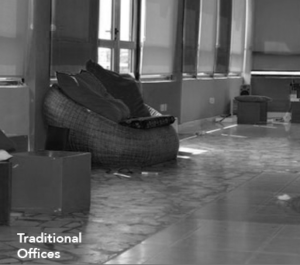
Characterized by individual workstations, traditional offices are the norm in many corporations, government agencies, and banks. Despite their structured layout, these spaces often limit flexibility and collaboration, leading to a decline in popularity.
– Rental cost:
Traditional workspaces often require long-term lease agreements with fixed monthly payments, which can be financially burdensome for small businesses and startups with limited budgets.
– Facility maintenance:
In traditional office spaces, you are typically responsible for covering utility costs, including water, electricity, cleaning services, and regular maintenance.
– Inflexibility:
You are confined to specific square footage for the entire lease term, unable to expand or contract your space to accommodate changes in your business size. This can leave you stuck with excess space or in need of additional room and a new office.
– Lack of interaction and communication:
Employees often work in isolated offices, limiting interactions with other departments. Additionally, individuals in the same industry tend to congregate, reducing opportunities to exchange knowledge and ideas with people from diverse backgrounds. However, there’s still potential to build relationships across departments, fostering collaboration and knowledge sharing.
– Productivity and its impact on work quality:
Distractions caused by nearby coworkers and noisy meetings can often hinder focus and reduce productivity.
– Lack of work-life balance:
Co-working spaces provide freelancers with autonomy over their workday, allowing them to create their own schedules. In contrast, traditional offices typically have fixed working hours and a more regimented environment. Although this can feel monotonous to some, it also offers a sense of predictability.
-Failure to adapt to market demands:
Traditional workspaces may not be suitable for many companies and remote workers who require personalized spaces and flexible hours.
When choosing a workspace, it’s important to weigh the benefits of a traditional office against the flexibility and cost-effectiveness of co-working spaces. If you’re seeking a dynamic environment and collaborative atmosphere, co-working is the ideal choice. However, if privacy and full control over your workspace are your priorities, a traditional office might be a better fit. Ultimately, the best option depends on your business goals and your team’s needs.