
Entrepreneurs, imagine you have a unique business idea, but you find yourself drowning in unfamiliar terms! That’s because you’re missing a key element – understanding their language.
Business terms and concepts aren’t just random words, they are powerful tools that help you make smart decisions, negotiate with confidence, and navigate smoothly with investors and competitors.
In this article, we will explore the essential terms for entrepreneurs that are indispensable for any innovator and business leader to achieve success in their field.
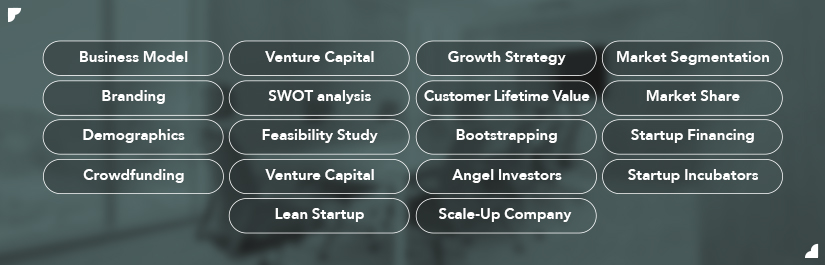
Business Model
A business model is the structure that defines how a company operates, it provides a clear blueprint for revenue generation, sales strategies, and marketing approaches. It also includes essential elements such as the target market, revenue streams, resource management, product or service delivery methods, potential income sources, and associated production and distribution costs, through this model, entrepreneurs can assess the feasibility of their project and make informed strategic decisions.
Venture Capital
Venture capital is a crucial funding source for businesses with high growth and innovation potential, it involves investing in startups that strive for significant success in the future, focusing on companies with groundbreaking concepts and promising opportunities. Venture Venture capital is not just about providing funds; it also includes strategic guidance and expertise for entrepreneurs from professional investors. While it is a high-risk investment, it offers a unique opportunity for growth and expansion in competitive markets.
Growth Strategy
A growth strategy is a plan aimed at increasing business operations and profits over the long term while ensuring sustainable expansion, this is achieved by growing market share and revenue through market expansion, product improvements, adding new product lines, or forming strategic partnerships. Entrepreneurs must carefully select the right strategy and conduct a thorough market analysis.
Market Segmentation
Market segmentation is the process of dividing the market into smaller segments with similar characteristics, It also involves categorizing these segments based on customer preferences and behaviors, this approach allows businesses to tailor marketing strategies to meet the specific needs of each group. By doing so, companies and entrepreneurs can target the most engaged and interested customers, enhancing the effectiveness of marketing campaigns.
Branding
Branding is the foundation of uniqueness in the business world and the face that reflects a company’s personality in the market, it’s not just a name or logo; it’s a comprehensive strategy that shapes how people perceive your company through unique design, a clear message, and exceptional services. A strong brand creates a connection that links quality and credibility to the products or services offered, fostering an identity that builds trust and increases customer engagement. In this way, branding becomes the key to long-term success and a solid position in the market.
SWOT analysis
SWOT analysis is a strategic tool that helps businesses and entrepreneurs understand the internal and external factors impacting their performance, the analysis examines four key elements: strengths, weaknesses, opportunities, and threats. By using this analysis, companies can identify their competitive advantages, pinpoint areas for improvement, and develop flexible and effective strategies that lead to optimal growth and expansion, it also supports decision-making to achieve success and market leadership.
Customer Lifetime Value (CLV)
Customer Lifetime Value (CLV) is a metric that shows the revenue a company can expect from each customer over their entire relationship with the company, it helps businesses prioritize attracting new customers and retaining existing ones, contributing to sustainable revenue growth in the long term, by understanding CLV, companies can improve their marketing strategies and offer excellent customer service, ultimately enhancing loyalty and increasing returns.
Market Share
Market share is the portion of the market controlled by a company relative to its competitors, the larger a company’s market share, the stronger its competitive position and ability to attract customers and outshine other brands. It helps businesses understand their impact in the market, evaluate their standing compared to competitors, and determine strategies for expanding their presence and increasing sales.
Demographics
Demographics refer to population characteristics such as age, gender, income, and education level, this information is crucial for accurately analyzing consumer behavior, enabling businesses to effectively target the appropriate market segments and tailor marketing messages. It is also instrumental in developing precise marketing campaigns to achieve optimal engagement and desired outcomes.
Feasibility study
A feasibility study is a comprehensive analysis aimed at estimating the success of a project from various financial, operational, and marketing perspectives, this study includes an evaluation of project costs, expected revenues, and target market analysis to ensure the project is economically viable. It also helps identify potential risks and provides solutions to mitigate them before actual implementation begins.
Bootstrapping
Bootstrapping is a method used to fund startup businesses without relying on external sources of finance, in this model, entrepreneurs rely on their personal resources, such as savings and early revenue, to cover operational expenses, thereby granting them full financial autonomy and eliminating the need for loans or outside investments.
Startup Financing
Startup financing refers to the financial support required by startups in their early stages to fund their operations and develop their products before entering the market, this financing can come from individual investors, venture capital firms, crowdfunding, or bank loans, each with its own terms and benefits.
Crowdfunding
Crowdfunding is a contemporary method of raising funds that relies on contributions from a large number of individuals via specialized online platforms, entrepreneurs can present their projects and ideas to gain direct support from the public, allowing people to invest in ventures they find interesting or promising.
Venture Capital
Venture capital is the funding provided by investors to high-risk startups that have great potential. This type of financing involves providing financial support to companies with innovative ideas, even though they may be at an unstable stage. In return, investors acquire a stake in the company for their investment and rely on the success of entrepreneurs to generate financial returns.
Angel Investors
Angel investors are individual investors who use their personal funds to finance startups at an early stage, in exchange for an ownership share or future profits, along with financial backing, angel investors offer their experience and network of connections to assist companies in scaling and succeeding. Startup Incubators: Startup incubators are specialized institutions aimed at helping early-stage companies by providing financial support, consulting services, office spaces, and connections to potential investors, this support helps companies overcome challenges and achieve sustainability and growth.
Startup Incubators
Startup incubators are specialized institutions aimed at helping early-stage companies by providing financial support, consulting services, office spaces, and connections to potential investors. This support helps companies overcome challenges and achieve sustainability and growth.
Lean Startup
The Lean Startup is a modern model for launching startups with limited resources, relying on minimal initial investment, it focuses on experimentation and gradual development based on immediate market feedback. This methodology reduces risks and helps continuously improve the product or service.
Scale-Up Company
A Scale-Up Company is a business that has surpassed the startup phase and is experiencing rapid expansion in both operations and revenue, with an annual growth rate exceeding 20% for three consecutive years. These companies, led by ambitious entrepreneurs, often have large teams and aim for market expansion and sustained success.
Finally, entrepreneurship is not just an idea but a language that every entrepreneur must master, each term represents a step towards smarter decision-making and the development of more successful ventures. Being knowledgeable in these terms provides businesses and entrepreneurs with a competitive advantage, enabling them to communicate in the language of the market, comprehend challenges, and confidently seize opportunities.